Showing posts with label books. Show all posts

03 November 2015

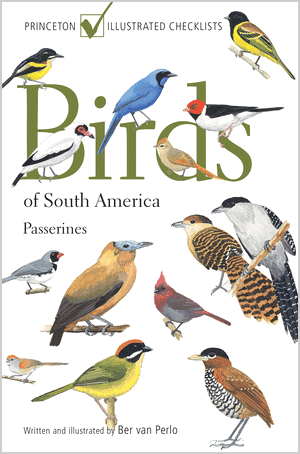
Book Review: Birds of South America: Passerines


Princeton University Press has put out another great bird guide!  Birds of South America: Passerines, written and illustrated by Ber van Perlo, is a quality guide to a large region.  It focuses on the passerines south of Panama and even includes islands of South America.  It tops out at 464 pages and is pretty heavy. I would say that the small size however does allow the option of carrying it in the field and certainly, it's good reference guide when learning South American bird families. This book is a companion guide to Birds of South America: Non-Passerines: Rheas to Woodpeckers by Jorge R. Rodriguez Mata, Francisco Erize and Maurice Rumboll.

Synallaxis & Ovenbirds

First, let me say how glad I was to see a new book out covering South America. Second, I LOVE that they included range maps beside each bird species description. I also love that the plates are beside the descriptions and everything is so concise and easy to read.  Some of the older guides I have of South America tend to keep the plates separate from the descriptions or the range maps are not easily found or non-existant.  I just like it all together and this book hits that square on the head.

The range maps are small and the fact that everything is so tightly packed into the pages may make it hard to read for those with eyesight issues but for me it's perfect. My only criticism with the book is the illustrations. I find them a little pale, a little wispy but they are detailed and I believe it's more of a style preference than a problem. Other than that small fact, I think this is a handy guide but you don't have to take my word for it, give it a gander yourself on this sample page.

This review copy was provided by Princeton University Press.

04 February 2015

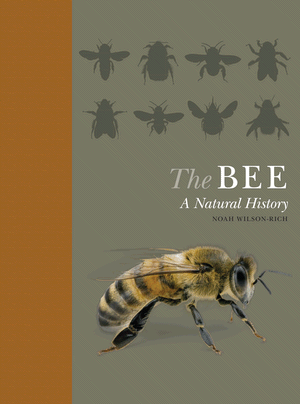
Book Review: The Bee


This book review is supplied by the talented Kat Shiffler - who knows a thing or three about bees.  

There is no shortage of books about bees. The eusocial honey bee has mesmerized scientists, philosophers, political scientists, artists and curious laypeople alike since the time of the ancient Egyptians. Apis mellifera, is often said to be the most-studied species, after Homo sapiens. But vastly overlooked are the world’s 20,000+ other fascinating bee species, most of which are solitary. That is precisely the unique contribution of Noah Wilson-Rich’s fabulous book, The Bee: ANatural History.

Wilson-Rich and other contributors have put together a rich reference; an engaging narrative explaining the big picture as well as practical hands-on discussions on hive management and bee health. The Bee goes further than any other bee book to explain and display in full-color, the astounding diversity that exists in this corner of the animal kingdom.

The book’s directory of notable bee species alone makes this a worthwhile purchase for any naturalist’s library. Never before have I seen such wonderful photographs and complete descriptions of the world’s species organized as solitary, stingless, bumble and honey bees. The Bee makes visible for the first time, lesser-known bee species that normally buzz just under our radar. They don’t make honey, but are vitally important for pollination and the health of the planet.


While the book’s scope is without precedent, some sections are more robust than others. The sections on bee evolution, ecology, genetics and physiology are wonderfully summarized, while explanations of the human-bee relationship over time could be more developed for my taste – indeed warranting another book.

Rich and his co-authors have made an important and unique contribution to a body of knowledge that seemingly has no end.


“The bee’s life is like a magic well: the more you draw from it, the more it fills with water.” – biologist Karl von Frisch

This review copy was provided by Princeton University Press.  Book review by Kat Schiffler.

12 January 2015

Book Review: The Passenger Pigeon


Errol Fuller writes beautifully about extinct animals in his book Lost Animals and this time he is back with a primer on all things Passenger Pigeon.  The Passenger Pigeon is a detailed history of how the blue pigeon went from being one of the most plentiful species in North America to one that vanished literally overnight.  The book is full of photos, drawings, and quotations from many famous naturalists and historians.  This is a must-have book for those that want a picture of what modern day extinction looks like and how simple it can happen before our eyes.

Passenger Pigeon chick, early 1900s


With so many books about Passenger Pigeons, I cannot say this is the most detailed book but it is concise, lavishly illustrated, and covers the whole process from early colonization of North America to the early 1900's when the last Passenger Pigeon left the Earth.  Perhaps what draws me to the book most is the plentiful photos and artwork.  The author himself states the book is a celebration memorial of a species lost and I believe that he does a wonderful job painting the picture of how and why this animal is no longer alive.  With 2014 being the 100 year anniversary of Martha's death I could see why such a book would be published.  For those that don't know Martha died in a zoo in 1914 but her preserved body and story continues to teach people about this species.  This book is a wonderful reference book and hopefully has helped bring awareness that extinction is a modern day problem.  There are even some people that are working to bring the Passenger Pigeon back from extinction, which you can learn all about at Revive & Restore.


"When an individual is seen gliding through the woods and close to the observer, it passes like a thought, and on trying to see it again, the eye searches in vain; the bird is gone."
-John James Audubon

This review copy was provided by Princeton University Press.

05 December 2014

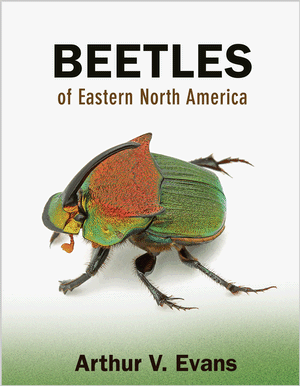
Book Review: Beetles of Eastern North America


Beetles of Eastern North America by Arthur Evans is a must read for any aspiring entomologist or naturalist.  I am proud to have this valuable resource and some of the photos are just works of art. The first 55 pages of this book is a wonderful primer to all-things beetle ranging from behavioral information to ways to breed beetles in captivity.  This whopping 500+ page book is not a field guide that you will take on your next hike but it's a wonderful book to use later when you've snagged a few photos of that interesting beetle encounter.


Each species description includes detailed size dimensions and distinguishing features.  The last sentence of each description also includes range information but I'm a visual person and would have loved a range map instead of text but it's a small critique to such a beautiful book

This review copy was provided by Princeton University Press.

09 September 2014

Book Review: Trees of Western North America


Being a science nerd came early for me.  In 6th grade I decided to join the Science Olympiads team at my school.  My assignment was Tree ID and I studied for the next 3 months so I could compete at the state level.  My tattered little Golden Guide to Eastern Trees was well used and supplemented by my advisors personal Tree ID collection that she had created in college.  Mrs. Hammond was so old that she had taught my mom in high school and even then, she wasn’t young.  So this old collection of leaves and my guide were all I had to take me to a Third Place finish at States.  I was ecstatic at winning but more importantly my love of trees had settled in quietly.

Being an East Coast girl my whole life made me always feel at home in any forest.  Even in South Florida I quickly picked up the new ones and the exotics to add to the growing collection of tree knowledge.  Then I moved to Colorado and what once was so familiar became foreign.  I admit, I have been slow to learn the new trees of the region but now I have no excuse because Trees of Western North America arrived for me to review and it’s given this tree-loving nerd a new mission.

On first glance, I really like that the illustrations provide a tree silhouette, a leaf, a fruit, and a bark sample for each specimen.  The bark is something that I haven’t seen in every tree guide and I really like it.  Coming in at just over 550 pages, this compact guide actually is fairly small in the hand albeit heavy. It’s a beautiful reference for nature buffs like me, for teachers, or even as a reference for more scientific pursuits.  I like that it’s very clear and concise while still packing a lot of information.  The range maps and the text are a little small but don’t present a problem with my current vision.  I think this would make a wonderful guide for anyone and who knows, it may just fall into the hands of a young middle-school kid and change his/her life forever.

But don't take my word for it, check out a book plate for yourself: http://press.princeton.edu/chapters/s10216.pdf

This review copy was provided by Princeton University Press.

13 March 2014

Book Review: The Extreme Life of the Sea


The Extreme Life of the Sea is a book that spins tale after tale of the secretive world of the ocean.  The Prologue opens with a story that reads like a scene from a movie with a whale battling a Giant Squid, in a fight for each other's life.  Each chapter tackles the fastest, the strangest, and the most bizarre.  It reads like a thriller but each story rooted in hard science.  If you have a lover of the sea at home, this would make an excellent gift.  The father/son team of Stephen R. Palumbi and Anthony R. Palumbi have crated a glorious book but you don't have to take my word for it, watch the video below to see the book come alive.


06 March 2014

Book Review: Ten Thousand Birds


Ten Thousand Birds by Tim Birkhead, Jo Wimpenny, and Bob Montgomerie is a massive volume of information on ornithology.  I especially like how the emphasis of the book was on the actual stories of ornithologists and their discoveries.  As someone that is trained in the sciences, I often wonder why science is always striving to disconnect from the human-related experience.  This book is a marriage of two of my favorite things: birds and storytelling.  Not to say the book lacks in facts because it seriously does cover a plethora of scientific knowledge.  But where it really shines it in the personal and it's evident in the small bios that are seen throughout the text.

My partner's reaction to seeing the book: "I want more pictures."
My reaction: "Wow, this is a heavy book but look at all the information and stories!"

A beautiful book, but seriously you may need to do a few workouts to hold it.  Want a sneak peek at what's inside: http://press.princeton.edu/links/birkhead/ten_thousand_birds_sampler.pdf

This review copy was provided by Princeton University Press.

12 February 2014

Book Review: Lost Animals


Lost Animals by Errol Fuller provides a photogenic account of the animals that are now lost to us through extinction.  The photos of the 28 species detailed in Fuller's book are remarkable.  Each species is given a detailed account with interesting insights to the last of the species.  I especially was intrigued by the account of the Carolina Parakeet and the lack of photos, except for two photos of captive individuals in private homes.  The photos of the Ivory-billed Woodpecker were also interesting and ones I had never seen before.  They were stunning!

Perhaps the most remarkable aspect of the book is that the photos are provided in their original detail.  No modifications or graphic enhancement is provided, but instead the author chooses to let the original photos speak for themselves.  The photos in this book give us the ability to really see a live individual before it was gone forever.  It makes one wonder how many more species will go extinct in our lifetime.

This review copy was provided by Princeton University Press.

17 December 2013

Holiday Shopping Guide

Do you have some last minute shopping? Here are my recommendations for your last minute shopping.  

Books:
Crossley came out with an outstanding new guide this year that lives up to his previous ground-breaking works.  I want one for every region and country of the world.  Check out the Britain & Ireland Guide: http://press.princeton.edu/titles/10102.html


Shoes:
If you're looking for boots for winter or a nice trail boot, look no further than Merrell.  I've been wearing there boots for 10 years now and they never disappoint: http://www.merrell.com/US/en

I bought my first pair of Keens this year and I must say, I am in love.  I was a die-hard Chaco fan for almost a decade but I now my Keens are the go-to trail shoe especially in Colorado where I often cross streams, hike mountains, and dip my feet in the ice cold alpine lakes.  You gotta get a pair and try'em out: http://www.keenfootwear.com/us/en/

Bags:
After a trip to Panama and Costa Rica, I must say that a nice waterproof bag will give you a safety net with those optics and they fold up to the size of a wallet to store in a pocket or bag for safe keeping until you need them.  I went out each day with my DSLR without any hesitation with my waterproof bag.  I like the Sealine waterproof bags personally:http://www.cascadedesigns.com/sealline

Lowepro Passport Sling will hold your DSLR, your optics, guides, and everything else for a day in the field. http://www.amazon.com/Lowepro-Passport-Sling-Camera-Bag/dp/B0039NLS4C/ref=sr_sp-atf_title_1_1?ie=UTF8&qid=1387308138&sr=8-1&keywords=lowepro+sling+camera+bag

Calendar:
You know you need to keep all those outdoor adventures organized.  Why not do it in a calendar that gives back to a good cause like the Larimer Humane Society's 12 of 12,000 Calendar Project.  Plus, Ms. December is the best bulldog in the world!  http://www.larimerhumane.org/events/12-of-12000


Other ideas:
Yearly Park Passes http://www.nps.gov/findapark/passes.htm, American Birding Association Membership https://aba.org/, or a Birdwatcher's Digest Subscription http://www.birdwatchersdigest.com/bwdsite/

07 November 2013

Book Review: The Kingdom of Fungi


The Kingdom of Fungi, Jens H. Petersen, Princeton University Press, 2013

The Kingdom of Fungi by Jens H. Peterson will take you into a intimate visual inspection of the fungi world.  At first glance, it's a coffee table size book with full spread color photos of some of the most unique and stunning mushrooms in the world but if you give it more than a glance you will find it an easy to read primer on the hidden kingdom of fungi. 
The book layout is simple with an introduction that is thorough and has fun charts and shots of micro and macro photos. Next is an overview of each type of fungi group.  The real beauty is that each page is rich with colors that draw the reader in while the text is short but to the point.  The writer clearly sees the power of photos and keeps each page interesting with a variety of angles and views of the fungi kingdom. 
My favorite parts are at the back in sections titles "Where fungi grow..." and "Why we need fungi..."  These two sections correlate this hidden world to every person on the planet.  By first allowing us to admire this fascinating world, the last section is a plea for us each to do our part and protect the future.  I find the rallying cry not only necessary but done in a convincing manner. 
Overall The Kingdom of Fungi is a perfect book for any nature enthusiast.  Consider picking up  a copy for your child, a fellow nature nerd, or even just spread the love of fungus to anyone you think may find the mysterious interesting.  I highly recommend adding this one to your collection if you are a fun-guy.  

Sorry, I couldn't help myself.


This review copy was provided by Princeton University Press.

29 October 2013

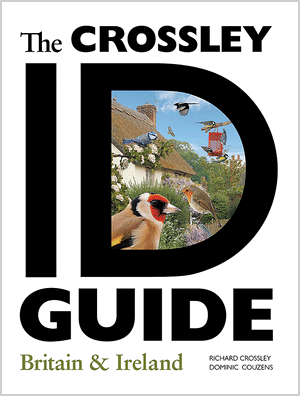
Book Review: The Crossley ID Guide: Britain & Ireland


The Crossley ID Guide: Britain & Ireland by Richard Crossley and Dominic Couzens arrived at my home on a rainy Colorado afternoon.  The perfect setting to crack open a new book and write a review.


On first glance, the ID Guide follows Crossley’s other books.  The Crossley plates are superb and really capture the multi-aspects of each bird.  I loved the scenic backgrounds but did find the people on the Coot plate distracting (pg. 150) and almost comical.  Most of the other plates with a human aspect like the Garden Warbler (pg. 248) didn’t create such distraction and seemed just part of the background.  I do like the size of this guide, it’s smaller than a big Sibley but not pocket size.  It’s a slender book with a size that allows the reader to fully appreciate the bird plates. The Goldfinch plate (pg. 284) is a work of art.  

I could look at these plates over and over.  Of course, that is the creators plan; to have us study birds over and over and really form a full picture of the bird so that it will be easier to ID in the field.  I found the introduction interesting and the bird plate text almost like poetry: “Abundant, adaptable, domineering all-black ‘wide boy’ among birds, found in woods, farmland, villages, towns, cities, rubbish tips – indeed almost anywhere” (pg. 200).  Crossley’s book describes the Carrion Crow as any true birder, with admiration.  I like that he isn’t afraid to deviate from the traditional, short descriptions and instead uses more colorful imagery such as “Feeds on ground, can walk or move with sinister, 2-footed hops.”  His descriptions of a bird I have never seen (the Carrion Crow) immediately entice me to visit and see this crow for myself.  I fear that every plate and text will draw me in like this.  

Thanks Richard Crossley for another great ID Guide and for encouraging me to go back to Britain, this time as a birder.  I will certainly be pouring over these pages before I go.

This review copy was provided by Princeton University Press.

06 September 2013

Warblers

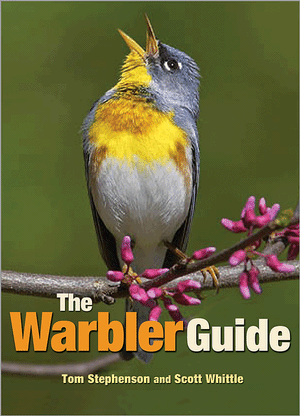
Identifying warblers in the spring of 2007 is what really got me hooked on birding.  I went to work early every day to identify Black-throated Blue Warblers and Cape May Warblers.  I fell in love with warblers and birding and being outside in the early morning hours with migration all around.

Princeton University Press is offering some beautiful warbler Quick Finder selections based on the new book The Warbler Guide by Tom Stephenson and Scott Whittle over at their blog.  You should download some of your favorites and while you're at it, pick up a copy of this new book.  Maybe you will fall in love as well, ore maybe you already have!   


12 March 2013

The Crossley ID Guide: Raptors and Everglades National Park


If you aren't familiar with The Crossley ID Guides by Princeton University Press, then get out from under that rock and join the rest of us!  When I first opened The Crossley ID Guide: Eastern Birds I was both inspired and impressed by the book plates.  This guide has taken it's graphic representation to a new level by showing birds in many settings and situations, all in focus on one page.  With such an interesting way to study birds, it's no surprise that the newest book out focuses on Raptors.  From the hawkwatchers, to the casual backyard birders, this book will offer insights to bird identification.  Go ahead, if you don't take my word for it, check out a sampler.


Let's take a stroll through Everglades National Park, Crossley Raptor style.  The Everglades is a birders ideal habitat.  It has interesting birds, rarities, and for the raptor lovers, this is a place that you can see a large number in both individuals and species.  One of the most common raptors in the park is the Red-shouldered Hawk.  While driving from the park entrance to Flamingo, I have counted dozens of Red-shouldered Hawks littering the roadside snags and flying over the marsh.  On a recent field trip to the Flamingo campground a friendly Red-shouldered Hawk caught prey with little to no interest in the middle school campers that I had with me.  While it was at times pulling teeth to get these urban Miami kids interested in nature, the Red-shouldered did the trick by swooping over their tent to catch small lizards.


On a hike out to the Gate 15 mound in Everglades National Park, you will be happy to find Snail Kites along the path.  Snail Kites are found near wetlands with Apple Snails and I really liked the Crossley ID plate that demonstrates a typical Snail Kite feeding style.  These guides aren't just pretty coffee table books, they show behavior and identification tools that you can take into the field with you.


Snail Kites are found year around but in the summer months at Everglades National Park, another kite species migrates to Florida.  No one can mistake the Swallow-tailed Kites with their deep forked-tail and bold white and black markings.  Often seen in early spring, these migrants are easy to spot on the open grasslands of the Everglades.


One of my favorites raptors of the Everglades is the Short-tailed Hawk.  This species can be seen near the forested areas of the park including the pine uplands around Long Pine Campground and Research Road.  In the Crossley plate above the white color morph is shown.  This raptor has a very restricted ABA range and many birders hope to see it while visiting the park.  Since it's usually seen on the wing, the ID plate provides a variety of flight options that may be seen in the field. 


Another range restricted raptor that can be seen in Everglades National Park is the White-tailed Kite.  By far the best place to see this species is at the end of Research Road near the Nike Missile Base.  Last summer I was even able to see a breeding pair there, perched on a snag.  The Crossley book gives us a plate with some typical behavior of hovering, perching, and gliding.


The Crossley ID Guides are meant to improve your identification skills by showing birds in different  poses, behaviors, and light conditions.  What I like about the new raptor guide is that it takes the idea of ID practice and provides mystery plates to help you hone your skills.  The plate above has a variety of raptors in different flight poses.  The species  are numbered so you can check to see if you're right.  This book is visually stunning, provides insight to bird behavior, and offers interesting identification tips.  If you're interested in birds and want to improve your identification, you shouldn't pass up the opportunity to own The Crossley ID Guide: Raptors by Richard Crossley, Jerry Liguori, and Brian Sullivan.  This book can be a reference guide, a coffee table conversation starter, and a great way to study birds from home.  It's not often that we are offered an identification tool that we can use at home that inspires us to participate like The Crossley ID Guides.


I hope you've enjoyed our little walk through the Everglades with Crossley plates. You should head over to The Fat Finch which has an article on raptors in Native American mythology and references the new guide as well.  The Crossley ID Guide: Raptors blog tour will be continuing all week and through next week, check out the Princeton University Press website for more details on what's to come and where to go.  


Two chances to win a prize!
Below are more raptors found in Everglades National Park.  Can you ID them?  The first person to answer correctly will receive a prize.  The second prize goes to the person that can list all the known raptors that have been seen in Everglades National Park.  Leave your answer in the comments.  There will only be one winner for each answer and the same person cannot win both. 


13 February 2013

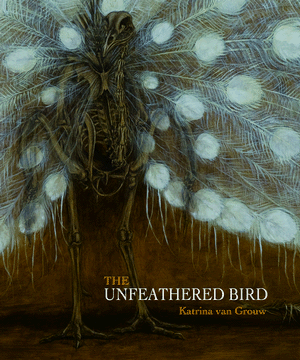
Book Review: The Unfeathered Bird


The Unfeathered Bird by Katrina van Grouw is a one-of-a-kind book.  This large coffee table book is full of the most spectacular sketches, drawings, and paintings all done from real specimens.  This time consuming project that spanned many years to create is something that you won't find anywhere else.  I especially love the birds that are posed in real world situations like the European Robin and Great Spotted Woodpecker below.


This book is like a marriage of a technical ornithology book and an artist's portfolio but even better because the text reads in an entertaining fashion for anyone that is interested in birds.  To learn more about this exciting new book check out Princeton University Press.  Also the NY Times just gave it a great write-up if you're interested here: Flights of Winged Majesty.

This review copy was provided by Princeton University Press.  All photos taken from The Unfeathered Bird.

01 February 2012

Book Review: Petrels, Albatrosses & Storm-Petrels of North America


Petrels, Albatrosses & Storm-Petrels of North America: A Photographic Guide is the cutting edge book on tubenoses by Steve N.G. Howell. At nearly 500 pages, this book gives an in-depth view of rarely studied pelagic bird species. While flipping through the pages I daydreamed of being on the water and watching birds stream by. This book will transport you into a new world of birds and not only give you photos to drool over but interesting life history information as well.


Many bird field guides are using photos and this one does the same but with a variety of angles and age cycles. When going on a pelagic trip taking a field guide with you is impractical but having a book like Howell’s will allow you to study while on dry land and be prepared on the boat for the next stray rarity. This guide covers all manner of tubernoses seen in North American waters and gives each one a detailed write-up.


Howell’s book will delight everyone from beginners itching to go on their first pelagic trip to veterans seeking new insights on these much desired species. This volume will provide the reader with tables, photos, behavior and insights into reproduction and life style. Howell has delivered the tools with this new book to help any person that has an interest in studying pelagic bird species. Get your sea legs ready, this book will have you dreaming of pelagic trips. With Howell’s information, you will be an expert on the boat!

This review copy was provided by Princeton University Press.

28 September 2011

Book Review: Trees of Panama and Costa Rica


Trees of Panama and Costa Rica by Richard Condit, Rolando Perez, and Nefertaris Daguerre is a beautiful tree field guide.  I love the bright plates that look like the real leaf is in your hand. 
The Peterson for botanists in the tropics, the Trees of Panama and Costa Rica is a delightful guide full of some of the best color plates I’ve ever seen.  Maybe not as detailed as Sibley’s Guide to Trees but in some ways, with those stunning photo plates, I found this guide more appealing.  The use of up-close bubbles to provide attention to detail is nice on the leaves and berries.  The range maps are well thought out and are included on the same page as the plates, which I love.  The text is small be detailed.  The only confusing part for those not so scientifically trained is the use of latin names but I find this helpful to avoid confusion among species.  In the tropics, with so many types of trees, it would be hard to classify the book in any other way. 

If you're planning a trip to Panama or Costa Rica (or any other Central American country for that matter) this may be the perfect guide for you if you wonder what trees you are walking under.  It's a little on the heavy side to take in the field, with almost 500 pages, but as a reference when taking photos of trees or mulling over a few small samples, this book should come in handy.  I am looking forward to giving this book a try when I visit Panama this year on my Canopy Tower trip. 

This review copy was provided by Princeton University Press.

30 August 2011

Book Review: Birds of the West Indies


Birds of the West Indies by Norman Arlott is a concise 240 page book that is considered an illustrated checklist by Princeton University Press.  What I found is that this little volume is more than a checklist but almost as grand as a full fledged field guide. The text was superb and provided many insights on the species and the plates are certainly colorful.  I especially like that the whole West Indies is covered.  As a travelor of the Carribean, this will be the perfect tome to keep in a bird bag as one island hops. 

With every great book there are a few setbacks and I could only find two with this one.  A personal pet peeve of mine is when the range maps are not found within the text and plates.  I know that this is an illustrated checklist and not a real field guide so this can be forgiven.  The other setback doesn't affect me personally but I will admit that the text is VERY small.  This volume packs a lot of punch and to include all the juicy tidbits the author decided to keep the font size little and the information big.  I am a fan of this and it's hardly fair to call it a setback but for some it may be an issue.

If you're planning a trip to the West Indies I would highly recommend adding this book to your library.  I think it would be the perfect addition in the field and small enough to fit in any travel bag.  I wish I had it on my last trip to Puerto Rico but I'm sure that I'll be back to the West Indies soon enough and this little guide will be going along with me for the ride.  

Princeton University Press has a whole line of Illustrated Checklists that cover diverse regions of the world if you're interested. 

This review copy was provided by Princeton University Press.  All photos taken from the PUP website.

20 July 2011

Book Review: The Atlas of Birds


The Atlas of Birds: Diversity, Behavior, and Conservation by Mike Unwin is a spectacular array of bird knowledge packed into one punch of a book.  The pages are both beautiful and breathtaking.  This is the perfect reference guide for the beginner birder or the armchair naturalist.  The maps and statistics grab your attention at every page turn and they are supplemented with stunning photos of birds from all over the world


What I loved were the quirky facts and stats like on page 90, a nice illustration of how many birds Shakespeare has used in his writing, or the beautiful pie graph on page 68, showing what birds eat.  I thought that the little details on highlighted species were well written and informative but I wanted more.  I thought this was a perfect beginner's guide but I wasn't satisfied with just the one quarter page on each family group.  Maybe I'm just such a fan that I wanted this to be a more comprehensive reference. I think for the size of the book though, Mike Unwin did well without overwhelming the reader.  Plus, I loved the flexible cover for packing in my carry-on at the airport!


If you're a naturalist, a bird-lover, or a student of fun facts then you should check out this atlas.  It will captivate your attention and keep you turning the pages.  Mike Unwin did an outstanding job and you better believe I will be checking out this reference time and time again.  If for nothing else, the Bird Table at the back will keep every bird lister salivating on future countries to visit.


This review copy was provided by Princeton University Press.  All photos taken from the PUP website.

09 June 2011

Book Review: Avian Architecture


First let me say that this is the perfect time of year for a book to come out on bird nests. Everywhere around me I'm seeing birds build nests and birds hatching. I'm sure I'm not the only one who has wondered how exactly a hummingbird constructs a nest. And let me tell you Avian Architecture: How Birds Design, Engineer & Build by Peter Goodfellow is the perfect book to give you a crash course on some basic bird biology/behavior in a fun format.


The photos are amazing but it's those step-by-step nest building sketches that are my favorite. I really love how Goodfellow divides the chapters by nest type and the case studies are really interesting and cover a good selection of birds from all over the world. You better believe I'll be using the "Blueprints" pages in my next Jr. Ornithology class this summer!


But don't let me convince you, take a look at these plates and I am sure you'll be signing up for your own copy soon!


This week at the Princeton University Press blog they have info on how you can win your very own copy of this book.


This review copy was provided by Princeton University Press.

20 May 2011

Book Review: Venomous Snakes of the World


I must confess I love snakes. Something about these reptiles appeals to me. Perhaps their odd lack of limbs or their unnerving lack of eyelids blinking, or maybe just the dangerous allure draws me in. No matter the reason, snakes truly are fascinating animals. That being said, I have always been cautious of venomous snakes and have kept a safe distance. This book will allow you the up-close look you've always desired.


As a child growing up in South Carolina I was often warned while playing outside to be on the look out for copperheads and rattlesnakes. More than once I heard the tell-tale rattle as I ran through the woods near my home but never was I too worried. As an adult I became even more interested in reptiles and spent many days hiking through Southern swamplands looking for herps. Oddly enough I rarely found many snakes. I have learned that snakes will always show up when you're not looking for them (like this week when I saw three different species in two days).


All my close-calls with venomous snakes have been quite pleasant. You can find a few posts here at The Flying Mullet such as my lifer Pygmy Rattlesnake encounter or my run in with a large "canebrake." But if you're looking for some really good stories about venomous snakes or just want to brush up on your snake knowledge then you must check out Venomous Snakes of the World by Mark O'Shea.


O'Shea breaks up the book by geography which is a little unusual but quite effective. In each section he covers species that represent the venomous snakes of that region. I really like his personal antidotes and tales of snake interactions. This guy really has had a lot of snake adventures and more than once has he had to tend to a snake bite from a deadly species. Venomous Snakes of the World is both entertaining and informative. For the armchair naturalist it is the perfect way to view these secretive animals. Though I am a snake lover I will admit that a few of these snakes I would much rather meet on the pages of this book than in the field. If you want a world of information on venomous snakes then look no further than Venomous Snakes of the World. I promise you that you will find the text entertaining and the photos unforgettable.


Princeton University Press has some great articles the author: Q&A with Mark O'Shea, details about his new book Boas and Pythons of the World, and a link to Mark O'Shea's website.


This review copy was provided by Princeton University Press.